Tests
Spirometry
Measures how much air you can blow out of your lungs and how fast.
What it is and what it measures
Spirometry is a lung function test of breathing mechanics that measures the diameter of the bronchus (the tubes that air passes through) from the outflow of air. It can be slow, forced or maximal-effort. The one that is most standardized is the forced one.
Spirometry with a bronchodilator test is done in order to show whether the patient has a significant response to bronchodilator. In it, three acceptable and repeatable maneuvers are done first, and then an inhaled short-acting bronchodilator medication (salbutamol) is given, or it can be a long-acting one (formoterol). The purpose of this test is to identify whether the patient has asthma, follow up on treatment and rule out diseases.
The use of salbutamol, 400 mcg, is standardized, but we can also use formoterol. Then there is a wait of 15 to 20 minutes to repeat the test.
It can be done from 5 years of age. Contraindications must be evaluated by the doctor who orders it.
Simple spirometry
Measures how much air you can blow out of your lungs and how fast, so it helps us in the diagnosis of obstructive patients.
More information about Simple spirometry (opens in a new tab)Spirometry with bronchodilator
Repeats the spirometry after a bronchodilator is given to see whether it has a significant response to the medication. The pulmonologist uses it to make the diagnosis of asthma.
More information about Spirometry with bronchodilator (opens in a new tab)Slow spirometry
Spirometry performed slowly, rather than as a forced or maximal-effort test.
More information about Slow spirometry (opens in a new tab)
When doctors order it
Spirometry is ordered for the purpose of evaluating lung mechanics. In every patient with respiratory symptoms, such as:
- Cough of more than four weeks, episodes of wheezing (whistling in the chest)
- Dyspnea (shortness of breath)
- Patients who have a rheumatologic disease
- In people who have jobs with dust, in factories, exposure to chemicals
- Patients with muscle weakness and a rib cage abnormality (scoliosis or curvature of the spine)
- Also, to evaluate the subject who is going to undergo surgery
- In individuals who are going to do a physical activity that demands effort from them (running). And for health research.
How it's done
We take your details and you sign an informed consent form (if you are a minor, your parent or guardian signs it). We also ask you a few routine questions, for example, what medications you have used recently or whether you have any allergies. We check your blood pressure, pulse and blood oxygen level.
The patient's details must be taken, such as first name(s), last name(s), date of birth, place of origin, whether they have been diagnosed with any disease, whether they smoke or not (patient registration).
Then the patient is measured and weighed in light clothing and without shoes (anthropometric measurements).
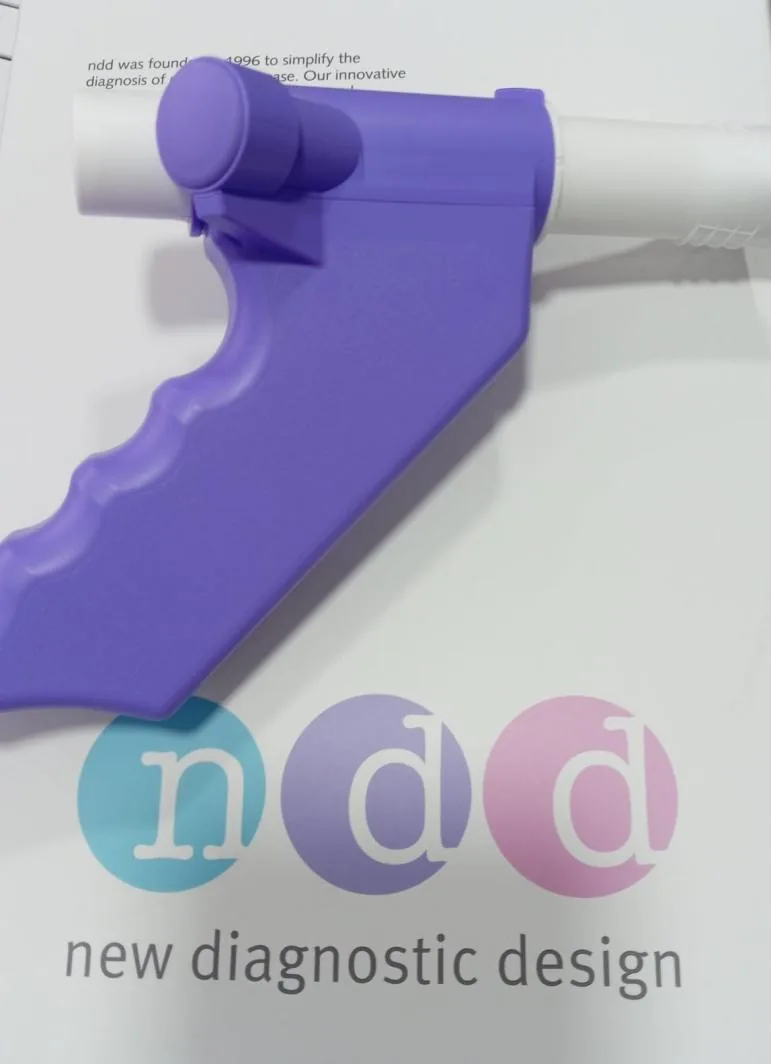
The patient sits in a chair, one with armrests; it is explained to the patient that they are going to do a test called spirometry, which consists of blowing into a mouthpiece with a filter in a forced way until they are told to take in air, and they are given a demonstration.
During the maneuvers the patient must have a clip on the nose so that only the air coming out of the mouth through the mouthpiece is recorded.
Three acceptable and repeatable maneuvers must be done.
If it is going to be done with a bronchodilator, 400 mcg of bronchodilator is given to the patient with a spacer, with an aerosol, and there is a wait of 15 to 20 minutes and the process is repeated.
How long it takes and how it feels
The duration is 30 to 40 minutes. Although it will depend on the patient.
The test does not cause pain; the patient is just going to blow.
It is a safe test, although when you blow out hard you may feel slightly dizzy, cough or feel tired for a few moments.
If it is with a bronchodilator, the medication may cause temporary discomfort, such as palpitations (a faster heartbeat) or shaky hands.
Tests at the same appointment: whichever the doctor orders and the patient cooperates. Example: spirometry, oscillometry, plethysmography, DLCO, etc. There is, though, an order so that the result of one of them is not affected.
Preparation
- You need a doctor's order.
- If you can, have on hand the names of the medications you use and of the doctor who referred you.
- If you are a minor, come with your parent or guardian.
- For everything else, follow the general preparation guide: this test has no instructions of its own.
Results
The results are interpreted by a doctor specializing in pulmonology with advanced specialty training in respiratory physiology.
The delivery time is one working day. They are delivered printed or by email. At this time they are not sent directly to the doctor, only if the patient indicates it.
This information is for guidance only and does not replace a medical consultation.
At the laboratory
Each test is performed with equipment designed for that measurement.