Tests
FeNO test
Measures the nitric oxide in the air you exhale, an indicator of inflammation in the airways.
What it is and what it measures
Both FeNO and FeNO Offline measure the nitric oxide produced by the airway and help us, among other things, to know whether the inflammation the patient is presenting is of the eosinophilic type (involving eosinophils, a type of white blood cell), as well as to evaluate the control of the treatment of inhaled medications. For its part, nasal FeNO (nNO) is a test that evaluates this eosinophilic production in the paranasal sinuses in order to evaluate the mobility of the cilia (microscopic hairs in the airways).
FeNO Offline is conventional FeNO, not nasal.
It can be done from 2 years of age onward, and if it is FeNO Offline, at any age (even patients a few months old), it has no contraindications.
For the nasal measurement, ask us on WhatsApp about the minimum age.
Fractional exhaled nitric oxide (FeNO)
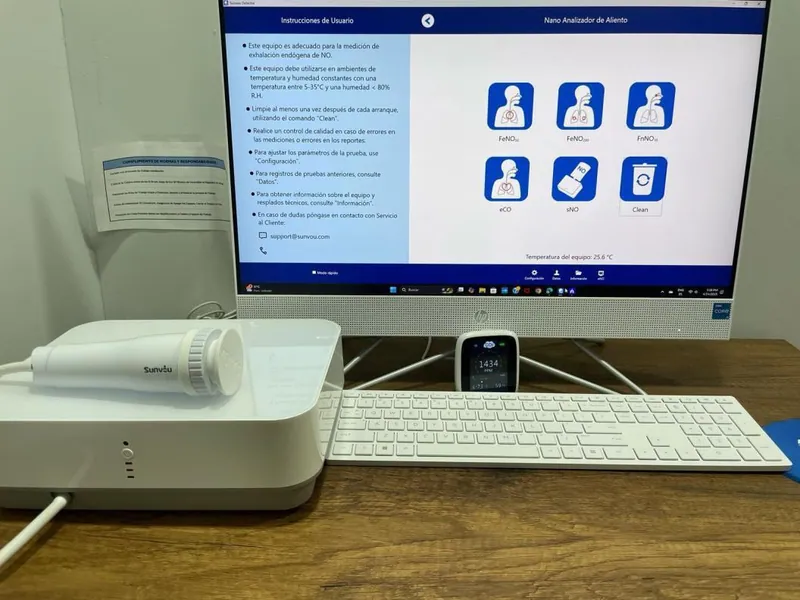
Measures the nitric oxide in the air you exhale, an indicator of inflammation in the airways, through a flow sensor, which can be chemiluminescence or electrochemical.
More information about Fractional exhaled nitric oxide (FeNO) (opens in a new tab)FeNO Offline
The exhaled air is collected in a bag-type container and this is placed in the device that is going to measure the nitric oxide, without the flow variable.
More information about FeNO Offline (opens in a new tab)Nasal nitric oxide measurement
Measures the nitric oxide produced in the nose and paranasal sinuses. It is used for the diagnosis of primary ciliary dyskinesia.
More information about Nasal nitric oxide measurement (opens in a new tab)
When doctors order it
Generally, in patients with:
- Cough
- Episodes of wheezing (chest tightness)
- For the follow-up of the disease such as asthma and also of chronic obstructive disease (COPD)
- In persistent sinusitis that is refractory to conventional treatment (that does not improve with the usual treatment)
How it's done
We take your details and you sign an informed consent form (if you are a minor, your parent or guardian signs it). We also ask you a few routine questions, for example, what medications you have used recently or whether you have any allergies. We check your blood pressure, pulse and blood oxygen level.
FeNO. As in spirometry, the following is done for the patient: anthropometric measurements and the patient is registered with their personal details.
Then the patient sits in a chair, it is explained to them that they are going to do a test that doesn't hurt and isn't uncomfortable.
A nose clip is placed on the patient; through a disposable mouthpiece, the patient is asked to blow, but steadily, but not hard, to maintain a flow.
Then the device records the information; depending on the device, one or three can be done to get the average of these.
Nasal FeNO (nNO). The steps carried out in the previous one are carried out.
In this step, a nasal olive is placed on the device's sensor and the patient is asked to place it in one nostril.
In addition, the patient is given a whistle so that they make it sound while they have the olive in the naris, to measure nasal FeNO as the palate rises.
FeNO Offline. The patient breathes at tidal volume (normal) into a device through the mask and it is deposited in a small disposable bag, and afterwards the small bag is placed in the equipment and it measures it.
How long it takes and how it feels
Each one can take 30 to 60 minutes; it will depend on the patient.
FeNO Offline: It doesn't hurt, it isn't uncomfortable. The time is about 20 minutes from the preparation of the patient.
Preparation
- You need a doctor's order.
- If you can, have on hand the names of the medications you use and of the doctor who referred you.
- If you are a minor, come with your parent or guardian.
- In this one it is important that topical nasal steroids (steroid nasal sprays) not be applied in the 4 hours before the test, if nasal FeNO (nNO) is going to be done.
- For the nasal measurement, the inhaler instruction in the general guide does not apply.
Results
The results are interpreted by a doctor specializing in pulmonology with advanced specialty training in respiratory physiology.
The delivery time is one working day. They are delivered printed or by email. At this time they are not sent directly to the doctor, only if the patient indicates it.
This information is for guidance only and does not replace a medical consultation.
At the laboratory
Each test is performed with equipment designed for that measurement.