Tests
Body plethysmography
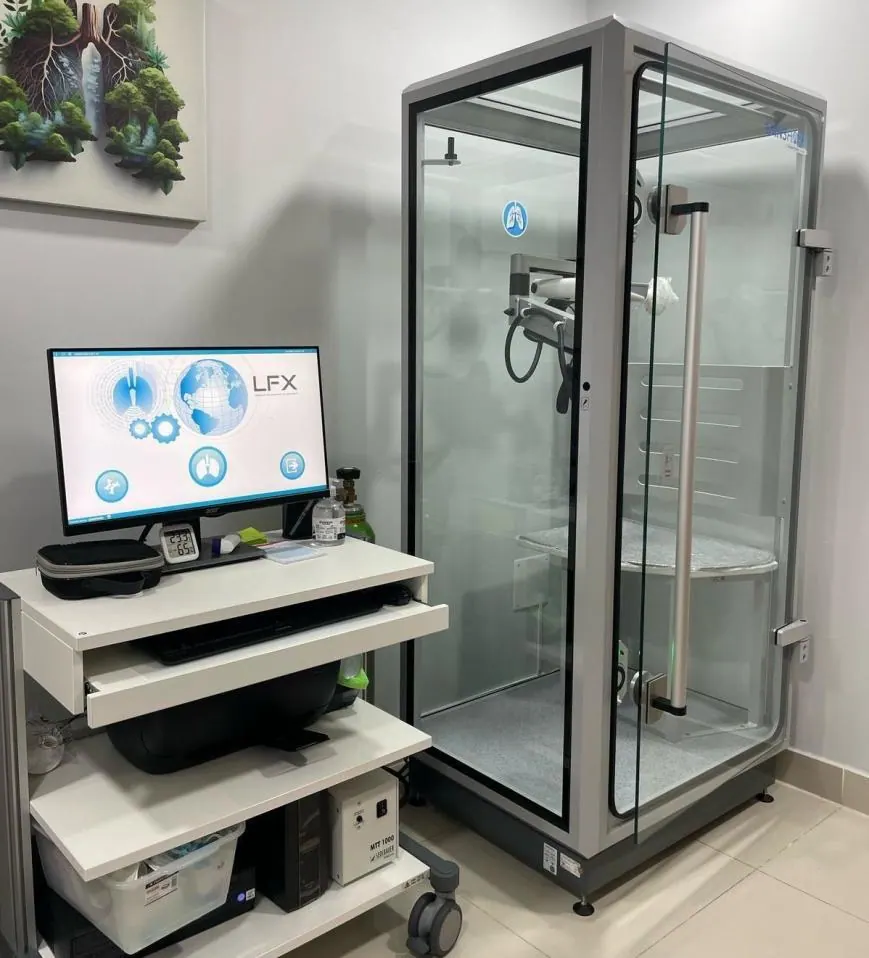
Inside a transparent booth, it measures all the air your lungs can hold, including what is left after exhaling (after all the air comes out).
What it is and what it measures
It is a lung function test of breathing mechanics that measures all the lung volumes and capacities (all the air that can fit in the lungs). It is the best test to be able to evaluate the part of lung function.
It can be performed in patients from age 5 to age 90.
When doctors order it
- In patients with abnormal spirometry
- Dyspnea (shortness of breath)
- Rheumatologic diseases
- Neuromuscular diseases
- Scoliosis (curvature of the spine)
- Interstitial lung diseases (they affect the lung tissue)
- Patient with COPD (chronic obstructive pulmonary disease)
- Asthma, especially those that are difficult to treat and those with severe asthma
How it's done
We take your details and you sign an informed consent form (if you are a minor, your parent or guardian signs it). We also ask you a few routine questions, for example, what medications you have used recently or whether you have any allergies. We check your blood pressure, pulse and blood oxygen level.
After the anthropometric measurements are taken, an explanation is given to the patient and the demonstration is performed for them. A simple spirometry must be performed beforehand.
The patient goes into the booth, which is transparent, and sits down; the filter is placed on the equipment and the nose clip is handed to the subject.
Instructions are given to put it on at the moment the maneuver starts and to place the hands on the cheeks.
The booth is closed, there is a wait for the calibration to be done (one minute), the patient places the nose clip on the nose, mouth on the filter and hands on the cheeks.
The patient starts with calm breathing (tidal volume) until reaching a stable functional residual capacity (FRC).
An occlusion of the mouthpiece occurs, in which the patient must perform a panting maneuver (short, quick breaths), then must breathe all the air out until reaching residual volume (RV).
And afterwards the patient must take in all the air until reaching total lung capacity (TLC), and breathes the air out.
At least three acceptable and repeatable maneuvers (good and similar to each other) must be performed.
How long it takes and how it feels
The duration of the test is related to the patient and their cooperation; the average is 30 to 40 minutes.
The booth opens immediately when a test ends, and there is a button inside that the patient can press if they wish to get out.
It is a safe test, although during the maneuvers you may feel slightly dizzy, cough or feel tired for a few moments.
Tests at the same appointment: whichever the doctor orders and the patient cooperates. Example: spirometry, oscillometry, plethysmography, DLCO, etc. There is, though, an order so that the result of one of them is not affected.
Preparation
- You need a doctor's order.
- If you can, have on hand the names of the medications you use and of the doctor who referred you.
- If you are a minor, come with your parent or guardian.
- Added to the general guide is whether the patient has any fear of being enclosed (claustrophobia).
Results
The results are interpreted by a doctor specializing in pulmonology with advanced specialty training in respiratory physiology.
The delivery time is one working day. They are delivered printed or by email. At this time they are not sent directly to the doctor, only if the patient indicates it.
This information is for guidance only and does not replace a medical consultation.
At the laboratory
Each test is performed with equipment designed for that measurement.